Creator Cinema • Integrator sisteme • Strateg Gen AI [PH.D.]
Sparring + Intervenții de impact în pregătirea afacerilor și vizibilitățiipentru era AI
Regie Semantică & Inovație Augmentată
Cercetare Academica si Artistica
Aici se află fundația teoretică a muncii mele. Această pagină reunește contribuțiile academice – publicații, conferințe, analize editoriale și capitole de carte – care investighează intersecția dintre cinema, arhitectura informatiei (IA), comunicarea semantică (modelată folosind principiile metadatelor si ale Web-ului Semantic) pentru a fi înțeleasă și de algoritmi) și inteligența artificială. Deși domeniile par diferite, toate explorările mele pornesc de la o temă centrală: cum decodăm, structurăm și comunicăm sensul într-o lume mediată de algoritmi? Acestea sunt metodologiile și perspectivele pe care le-am explorat și dezvoltat.
The Weight of 2 Million Walls: Visual Research on Sustaining Dignity in Aging Alone in Romania
September, 2024 • Presentation
Mihalcea, Georgia
Overview
This presentation and artistic research essay—developed within my doctoral research in Cinema and Media at UNATC "I.L. Caragiale"—serves as a theoretical and visual meta-discourse…
Overview
This presentation and artistic research essay—developed within my doctoral research in Cinema and Media at UNATC "I.L. Caragiale"—serves as a theoretical and visual meta-discourse derived from the creation process of a social ad-film. It contextualizes the hidden reality of abandoned or alone elderly individuals for whom, between their last days of stepping outside and their final day on Earth, an entire other lifetime may pass—an existential span defined by a single, continuous battle: the one for dignity.
Originally delivered at the international SPOTLIGHT Seminar – Staring at People. Interdisciplinarity and ambiguity of playing with the visibility of humans in cities (2024), the work functions as a derivative artistic product that applies the "From Numbness to Narrative" methodology to the data and field-insights gathered during the filmmaking process.
Abstract, Methodology & The AI Visual Gallery
As a direct derivative of the filmmaking process, this work features part of the visual gallery created with Gen AI. Here, the metadata of the original film's creation was further utilized to construct the gallery, seeking to uncover and offer fragments of the truth regarding the plight of Romania's 2 million elderly living alone that could not be fully captured or rendered within the film itself.
By taking the empirical data, field photographs, and heavy emotional realities experienced during production, these elements were structured as metadata inputs and translated into prompts. The resulting imagery acts as a conceptual and psychological extension of the film, translating cage-like urban architectures into a symbolic landscape of dignity in isolation.
This process demonstrates how a filmmaker can operationalize the emotional debris of a real-world shoot to decode and reconstruct or expand complex social narratives through machine-augmented art.
Institutional and Academic Validation
This research was disseminated and peer-reviewed as part of an international academic collaboration:
Host Institution: National University of Theatre and Film "I.L. Caragiale" (UNATC- CINETic), Bucharest, Romania
Co-organizers: University of Opole (Poland) & UNATC
Partners: University of St. Gallen (Switzerland), New Europe College (New Europe Foundation), HUN-REN Research Centre for Astronomy and Earth Sciences (Hungary).
Political & Social Impact: The film was originally premiered at the Romanian Parliament (Senate Health Commission, June 19, 2024) during the event 'Innovation and Quality in Long-Term Care: Perspectives and Practices'.
Project Assets & References
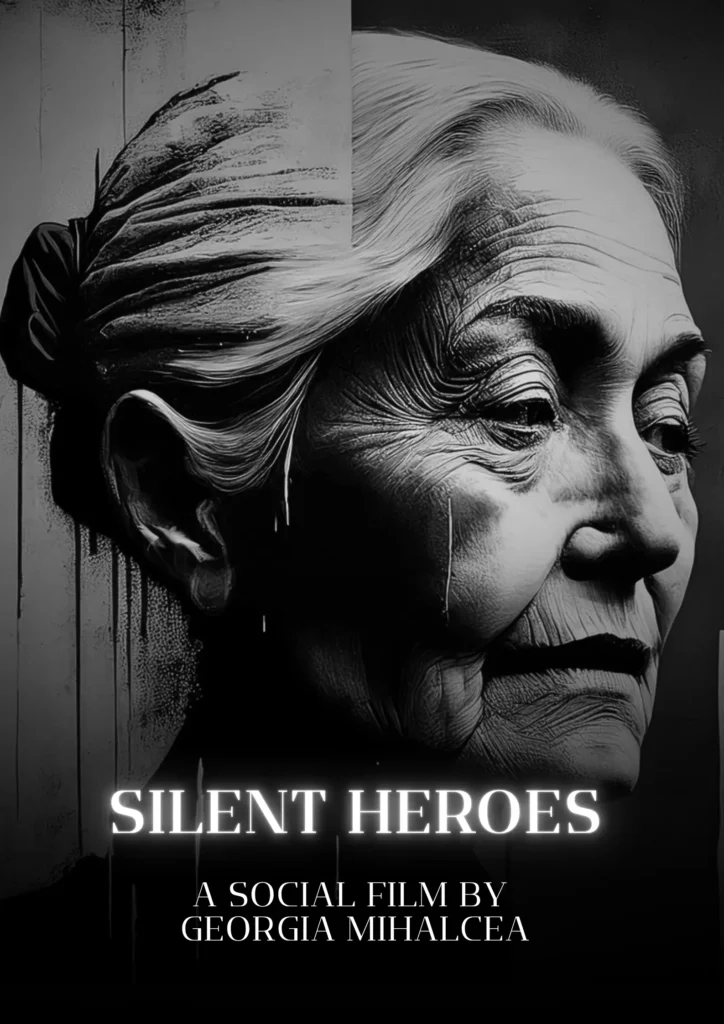
Associated Social Ad-Film: Watch "Silent Heroes" (Eroii din Umbră)
From Numbness to NarrativeAI-generated gallerymetadata-driven artemotional architectureRomanian elderly
Directing the Algorithmic Gaze: A Framework for Machine-Readable Films
December, 2025 • Presentation
Mihalcea, Georgia
Bridging the Dual Audience: Aligning Human Intent with Algorithmic Logic
The contemporary film industry faces a dual systemic crisis: an architectural inequality rendering films invisible to algorithm…
Bridging the Dual Audience: Aligning Human Intent with Algorithmic Logic
The contemporary film industry faces a dual systemic crisis: an architectural inequality rendering films invisible to algorithms due to legacy workflows that result in creative outputs as black boxes or unusable data, severely limiting their discoverability and structural integrity, and a production barrier gated by platform monetization models and automated distribution patterns. This dynamic leaves independent creators vulnerable to the "Algorithmic Gaze" – an external system that misinterprets, curates, and normalizes their work.
Within this landscape, cinema serves as a highly complex laboratory—an art form that inherently encompasses text, image, sound, and temporal editing, making it the ultimate testing ground for narrative systems (with direct scalability to the broader creative industries and digital media sectors).
For independent and marginalized voices, this structural gap creates a triple vulnerability—cultural, economic, and algorithmic.
This methodology addresses the fundamental challenge of content that is born structurally invisible to digital infrastructures, aiming at translating abstract narratives into executable operational layers.
In the context of this research, a machine-readable film is not a different kind of film, but a film that behaves differently.
From Form-First to Meaning-First for Enhanced Visibility
This presentation—developed as an integral part of my doctoral thesis in Cinema and Media at UNATC—proposes a paradigm shift to Meaning-First Cinema. In the context of the Semantic Web, this means structuring sense not only for human audiences, but also for algorithmic processes.
Responding to the industry's post-factum patchwork solutions for digital visibility (such as reactive data tagging, content enrichment, or traditional SEO and marketing), this framework bridges cinematic design with Information Architecture (IA), fundamental metadata, AI, and Semantic Web principles.
By approaching the film as a self-communicating narrative system, it enables the creator to utilize the work’s native ontology and artistic vision as an "Aesthetic Operating System" to ensure core intelligibility for human, AI, and algorithmic audiences alike.
As a filmmaker, I approach this issue through the lens of artistic practice and the realities of self-distribution. While introducing a framework for the digital and algorithmic literacy of the cinematic work itself—which inherently fosters the digital literacy of the filmmakers, film producers and distributors—this approach is specifically tailored to fit their workflows and to address the present gaps in the traditional supply-chain. It may also prove useful for technical specialists or developers interested in the specifics of cinema, helping them build applications or workflows that better support the creative process.
From Pixel Manipulation to Semantic Design: Structuring the Creative Vision
For demonstration, the methodology utilizes an applied workflow where an AI-augmented short film is constructed via an Informational Montage process, proving that shifting focus from pixel manipulation to semantic precision bridges the gap between human intent and machine response. Crucially, it reveals that the creator’s structured semantics act as superior "sources of truth" compared to traditional distribution pathways or empirical prompt engineering.
By encoding cinematic vision into an architecture that is easily translatable into structured data, filmmakers achieve a multimodal objective: story and communication resonance, production efficiency and organic discoverability.
This methodology highlights a new dimension for creative leadership—directing not just a crew or a project, but the underlying digital infrastructure itself, transforming the film from an isolated destination into a transparent node wired directly into the network.
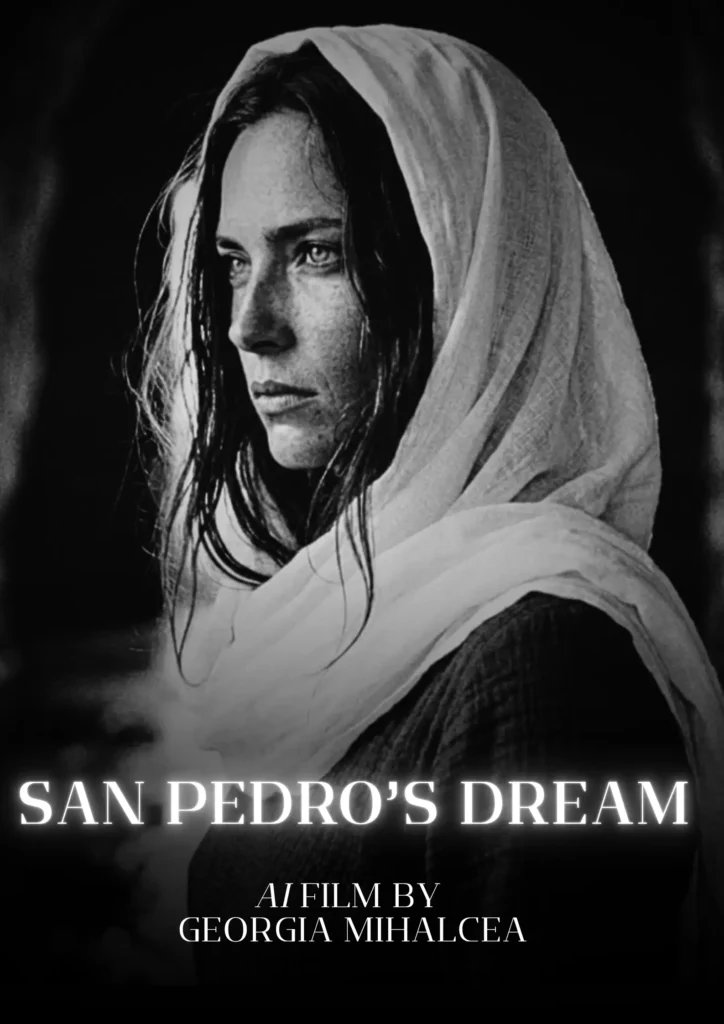
The final cinematic outcome demonstrating this architecture can be accessed here: Watch "San Pedro’s Dream" (2026, 3 minutes, AI-augmented short film).
Dissemination and Dual-Track Validation
This transdisciplinary research has been successfully peer-reviewed and disseminated across dual tracks:
National Track (In Romanian): Presented at CINETic during the institutional research seminar "Stimularea și diseminarea rezultatelor cercetării în cadrul UNATC 2025" (Stimulating and disseminating research results within UNATC 2025).
International Track (In English): Presented at the international hybrid conference "Women in Film: Leadership, Creativity, and Interdisciplinary Perspectives" (organized by Creatrix Fama and UNATC).
Note: This repository contains the original presentation assets in both English and Romanian.
The Unindexed Internal Web: Structuring Human Emotions as Metadata for Narrative Decryption
November, 2024 • Poster
Mihalcea, Georgia
From Numbness to Narrative: A Methodology for the Rapid Processing of Reality and Emotions
Emotional connection and clarity have never been greater challenges in the digital landscape. Developed throu…
From Numbness to Narrative: A Methodology for the Rapid Processing of Reality and Emotions
Emotional connection and clarity have never been greater challenges in the digital landscape. Developed through an autoethnographic approach and practice-based research rooted in real-world film production experience, this study of narrative decryption addresses the problem of creative confusion and emotional friction in creative communication-in this particular case filmmaking.
Rather than presenting an axiom, this framework introduces a personal observation: the human emotional system can be analyzed and navigated much like an unindexed web.
The objective is achieving communication resonance by creating a perfect alignment between three core pillars:
the creator's internal narrative
the story's narrative presented to the human public
the story's semantic architecture required by the algorithmic and AI systems.
Officially presented within the Pedagogical Innovations in Education session at ICERI2024, accompanying the paper "From Numbness to Narrative", this approach demonstrates that applying an algorithmic mindset to the human emotional system reveals a "structured vocabulary of emotions".
Ultimately, this validates the premise that within an algorithmically processed, fragmentation-inducing digital landscape, we achieve better story resonance and effective communication by integrating computational thinking into our internal decryption and creative processes.
The Emotional System as an Unindexed Web
Our emotional system functions as an unindexed internet, where blocks (numbness) represent merely a lack of metadata (or tags) that would make emotions detectable—often stemming from an incorrect, incomplete, or flawed naming of internal emotions, external situations, and visual realities.
Born from the practical challenges of navigating complex narrative shifts during an emotional demanding film shoot, this framework demonstrates that AI is not a substitute for human thinking. Instead, it may serve as a precision tool for refining metadata attributes and providing an audiovisual transposition of the inner landscape when combined with generative image, sound, video, and music models.
The Challenge of Dual Storytelling
This work explores how we can transform internal confusion, mislabeled real-world situations, and creative blockages into impactful narratives and decision-making. Navigating this friction highlights the core challenge of dual narration: achieving effective communication that resonates equally across dual audiences—the emotional depth of the human public and the multimodal structures of algorithmic and AI ecosystems.
Case Study: Application and Practical Outcome
This specific project served a dual purpose as a social awareness and fundraising short ad-film dedicated to the cause of isolated elderly people ("ageing in place" challenges) and the critical need for home care medical services.
Filmed with real people inside their own homes—where one of the real-life subjects sadly passed away during the process—the communication challenge drastically amplified during its rollout.
Rather than remaining a standard awareness campaign, the foundation successfully elevated the project to a major institutional level. The film was officially launched at the Palace of the Parliament during a high-profile event co-organized by the Senate's Health Committee and the foundation. This pivot required the narrative to rapidly adapt and achieve resonance across substantially different audiences simultaneously: from the empathy of the general public to the structural and legislative focus of political decision-makers.
You can watch the final outcome here:
Silent Heroes (Original title: Eroii din umbră), 2024, short ad-film, 1:48 min.
structured vocabulary of emotionsemotional decodingnarrative decryptionunstructured contentinformation retrieval in storytelling
2025:A Million Silent Rooms: Ageing Alone in Romania(Visual Research in the Semi-Peripheries: Spotting the Invisible, Representing the Present, Bloomsbury) (capitol carte, în curs)